The God Who Never Burns
Before we talk about hell, we have to establish a baseline, and that baseline is God’s character. Not the character of some doctrine about God, but the character God has on record in His own Word. And here is what the record shows: God is light, and in Him is no darkness at all (1 John 1:5). He never changes (Hebrews 13:8). Jesus is the exact image of the Father (Hebrews 1:3). And whatever Jesus never did, the Father never does. That is the reset button. That is how you read every difficult passage in the Bible: you hold it up against Jesus in the Gospels and ask, did He do that? Did He ever do anything like that? The answer shapes everything.
How many people did Jesus kill? No one. How many did He punish? No one. How many did He curse? No one. How many did He deny healing? Zero. On the contrary, He gave life, He rescued, He refused to stone the woman caught in adultery, He wept over Jerusalem when destruction was coming. The express image of the Father wept over curse. The Father does not celebrate destruction. He grieves it. Jesus is the proof.
“If you had known, even you, especially in this your day, the things that make for your peace! But now they are hidden from your eyes.”
Luke 19:42 · Jesus weeping over Jerusalem
Here is the anchor of this entire teaching: God is not a hypocrite. Whatever He teaches against, He cannot do Himself (Matthew 23; Luke 12:1). And what did God teach against, over and over, in Scripture after Scripture? He taught that burning people alive is an evil abomination.
This is not a single verse. It is fifteen to twenty passages. Let’s look at them directly:
“They have built the high places of Tophet, which is in the valley of the son of Hinnom, to burn their sons and their daughters in the fire, which I did not command, nor did it come into My heart.”
Jeremiah 7:31 · God says it never even entered His mind
“They built the high places of Baal which are in the Valley of the Son of Hinnom, to cause their sons and their daughters to pass through the fire to Molech, which I did not command them, nor did it come into My mind that they should do this abomination.”
Jeremiah 32:35 · Burning people called an abomination He never imagined
“Do not give any of your children to be sacrificed to Molek, for you must not profane the name of your God. I am the LORD.”
Leviticus 18:21 · Explicit prohibition against burning children
“You shall not worship the LORD your God in that way, for every abominable thing that the LORD hates they have done for their gods, for they even burn their sons and their daughters in the fire to their gods.”
Deuteronomy 12:31 · Burning in fire called something God hates
“Moreover you took your sons and your daughters, whom you bore to Me, and these you sacrificed to them to be devoured. Were your acts of harlotry a small matter, that you have slain My children and offered them up to them by causing them to pass through the fire?”
Ezekiel 16:20-21 · God’s grief at burning called out explicitly
“He defiled Topheth, which is in the Valley of the Son of Hinnom, that no one might burn his son or his daughter as an offering to Molech.”
2 Kings 23:10 · Josiah’s reform: defiling the very valley that became “Gehenna”
Six passages, and we have not exhausted the list. Jeremiah 19:5, Ezekiel 20:31, Psalm 106:37-38, and Isaiah 57:5 repeat the same verdict throughout the entire Old Testament. God calls this practice evil, abominable, something He never commanded and never imagined. And this is the doctrine he is now supposed to practice for eternity? The God who condemned burning people alive is somehow going to burn people alive forever? That is not theology. That is an accusation.
Add to this: God’s fire in Scripture consistently purifies; it does not torture. In Isaiah 6:6-7, a live coal from the altar touches the prophet’s lips and removes his iniquity, with no pain described, only cleansing. In Malachi 3:2-3, God is a refiner’s fire and a launderer’s soap; both images are of purification, not punishment. In 1 Corinthians 3:13-15, a man’s works are tested by fire, the works burn up, but the man himself is saved, “yet so as through fire.” God’s fire destroys sin. It saves people. That is its purpose throughout Scripture.
God declared burning alive evil. God does not change (Hebrews 13:8). God is not a hypocrite (Matthew 23). Therefore, God will never burn anyone alive: not in this life, not in the afterlife, not for eternity. The doctrine of eternal hellfire accuses God of the very thing He called an evil abomination over fifteen times. It calls evil good, which Isaiah 5:20 pronounces woe upon. We want no part of that. We want the truth.
Eternal Doesn’t Mean Eternal
Once you understand that God called burning alive an abomination, you still have to deal with passages that seem crystal clear about eternity in English, such as Matthew 25:46 (“everlasting punishment”), Revelation 14 (“the smoke of their torment ascends forever and ever”), and Daniel 12:2 (“everlasting contempt”). How do we address these? We go to the original languages.
The three words translated throughout our Bibles as “eternal,” “everlasting,” and “forever” are the Hebrew word olam and the Greek words aion and aionios. And when you look at what these words actually meant when the Bible was written (not what our modern dictionaries say, not what translators preferred, but what the ancient Greek and Hebrew lexicons confirm), a completely different picture emerges.
The proof is right in the text. Jonah was in the belly of the fish for three days and three nights (Jonah 1:17). Yet Jonah 2:6 in the King James says the bars of Sheol were about him “forever.” The word is olam. Three days is not forever. This is not a theological dispute. It is a factual error in translation. The word olam means an unspecified age of time, and the context tells us how long: three days.
This same word was used for the Day of Atonement (“forever”), which ended at the cross after about 1,400 years. It was used for Solomon’s Temple (“forever”), which stood 374 years. It was used for circumcision (“everlasting covenant”), abolished in Christ. Hundreds of examples throughout the Old Testament were mistranslated into eternity words, all representing ages of time with a beginning and an end. The pattern is undeniable.
The ancient translations that get this right (Rotherham, Young’s Literal, the Concordant Literal, Jonathan Mitchell’s New Testament) all translate Matthew 25:46 as “age-abiding correction,” “age-lasting pruning,” or “chastening aeonian.” That is not what we were taught. But it is what the Greek actually says. And the word for punishment, kolasis, rooted in kolazō, literally means pruning a tree: cutting away the dead and diseased portions to make the tree more fruitful. God is the vine dresser (John 15). He prunes. His goal is restoration, not retribution.
Purifying Fire & Three Days in Hades
Now that we know “everlasting” does not mean everlasting by default, two questions remain: What kind of fire is God’s fire? And how long does this age of correction actually last?
Isaiah 6 answers the first question permanently. Isaiah went into the presence of God. An angel took a live coal from the altar fire and touched it to his lips. What happened? Not screaming. Not agony. Not horror. The fire removed his iniquity. It purified him. That is what God’s fire does: it destroys sin, not people. Malachi 3:2-3 says the same: God is like a refiner’s fire, like a launderer’s soap, and the goal is to remove the impurity, not destroy the vessel. First Corinthians 3:13-15 says a man’s works can be burned, yet the man himself still saved “as through fire.” Purifying, not torturous.
“He will sit as a refiner and a purifier of silver; He will purify the sons of Levi… that they may offer to the LORD an offering in righteousness.”
Malachi 3:3
Now, how long is the age of Hades? Three days. We know this because Scripture establishes it with three witnesses.
Witness one: Jesus. Jesus bore all the sins of all humanity (past, present, and future), and the cost of that complete payment was three days in Hades (Matthew 12:40; Acts 2:27-31; Psalm 16:10). No individual person’s sin can exceed what Jesus paid for the entirety of humanity. The absolute maximum anyone could spend in Hades is therefore three days. That is what it cost for everything. No single account can exceed the total bill.
Witness two: Jonah. Jonah died. His body was in the fish. His spirit was in Sheol, which is Hades. He was there three days and three nights, and then he prayed and was rescued (Jonah 2:1-6). Acts 2 says Jesus’ descent into Hades fulfilled the Jonah type. Three days. Prayer. Rescue. This is the pattern.
Witness three: Egypt. The ninth plague: three days of absolute darkness over the land (Exodus 10:21-23). The Hebrews had light in their dwellings; the Egyptians experienced complete, tangible, terrifying darkness. A physical type-and-shadow of the darkness of Hades. Three days. Then morning comes.
Someone might say three days does not sound so bad. Here is the sober word: 2 Peter 3:8 says a day with the Lord is like a thousand years. If time is experienced differently in Hades, and there is every reason to believe it is, three days could feel like three thousand years. And you miss every present-life benefit of salvation: health, protection, provision, peace, joy, and victory. We do not want one moment in the darkness. We want Jesus, now and forever.
Hell Words: Worms, Fire, and What They Actually Mean
The English word “hell” is a fabrication. The King James Bible took four entirely different original language words and collapsed them into a single English word: hell. These four words refer to completely different realities, and blending them together has produced theological catastrophe for 500 years.
Sheol (Hebrew, Old Testament): The spiritual realm where the spirits of the dead go. It appears 31 times in the Old Testament. A place of darkness, distress of soul, and anguish, but never fire. Not once. Jonah prayed from Sheol and was rescued. God sees and hears in Sheol. It is reversible.
Hades (Greek, New Testament): The Greek equivalent of Sheol, used 11 times in the New Testament. A realm of judgment and darkness. Satan has authority there; it is his domain. It has gates (Matthew 16:18). Spirits are held in chains of darkness (2 Peter 2:4, Jude 1:6). Not fire. Darkness. But Jesus holds the keys (Revelation 1:18).
Tartarus (Greek, New Testament): Appears once (2 Peter 2:4). From Greek mythology, a sub-chamber of Hades for the most extreme offenders: fallen angels from before the flood. Chains of darkness. Not fire.
Gehenna (Greek, New Testament): This is where every “hellfire” passage comes from. Jesus used this word twelve times. And Gehenna is a physical valley on the southwest side of Jerusalem. Its Hebrew name is Gay Hinnom. It was called Tophet because children were sacrificed there for centuries. By Jesus’ day, it had become the city dump, with trash burning and bodies discarded after battles. Worms eating. Fire consuming. The worm does not die. The fire is not quenched. Because of the corpses.
AD 70. The Roman siege of Jerusalem. Josephus, the Jewish historian with no theological agenda, records it in devastating detail. 1.1 million people died. Bodies were thrown over the walls into the Valley of Hinnom. 115,880 bodies were carried out of a single gate in under three months. People resorted to cannibalism inside the walls. This is exactly what Jesus wept over in Luke 19. This is what He was warning about when He said it is better to cut off your hand than go to Gehenna. A warning about the coming physical curse. Not a spiritual afterlife of fire.
Fear Him Who Kills Body and Soul: But Who Is “Him”?
Matthew 10:28 has been read for centuries as a warning from Jesus about God: fear the Father, who can throw you into hell. But look carefully at who Scripture says has the power of death, and the passage unlocks completely. Hebrews 2:14 is unambiguous: “He Himself likewise shared in the same, that through death He might destroy him who had the power of death, that is, the devil.” The devil has the power of death. Not the Father. The Father raised Jesus from the dead. The Father is the author of life.
“And I say to you, my friends, do not be afraid of those who kill the body, and after that have no more that they can do. But I will show you whom you should fear: Fear him who, after he has killed, has power to cast into hell; yes, I say to you, fear him. Are not five sparrows sold for two copper coins? And not one of them is forgotten before God. But the very hairs of your head are all numbered. Do not fear therefore; you are of more value than many sparrows.”
Luke 12:4-7 (NKJV) · The lowercase “him” in the ESV correctly reveals two different entities
Luke 12:4-7 makes the contrast explicit. The ESV correctly uses a lowercase “him,” because Jesus is comparing two different entities. One who kills and casts into Gehenna: the devil, who has the power of death, who operates through the law and through curse. And the Father, who counts the hairs on your head and loves sparrows, whom you are explicitly told not to fear. The capital H in most translations was added by translators who already held the wrong theology, and it reversed the meaning of the passage entirely.
The “soul destroyed” in this passage is not annihilation. All spirits are resurrected (John 5:28-29). What it means is the Gehenna curse: the physical torment of AD 70, the madness, the trembling, the anguish, the horror described in Deuteronomy 28. All of that is the work of the devil, the one with the power of death, not the work of a loving Father who sent His Son to redeem us from every bit of it.
Jesus Descends: The Rescue Mission in Hades
When Jesus died, He did not simply wait in a pleasant holding place for three days. He went on a mission. He preached. He rescued. He led captives to freedom. And Scripture is explicit about every step.
Satan’s location, according to Scripture, is Sheol, Hades, Tartarus: the lowest pit. Isaiah 14:12-15 describes his fall: “You shall be brought down to Sheol, to the lowest depths of the Pit.” He rules from there, which is why Jesus spoke of the “gates of Hades” in Matthew 16:18. Gates represent authority. The enemy’s seat of power is the darkness of Hades. And Jesus said those gates would not prevail against the Church.
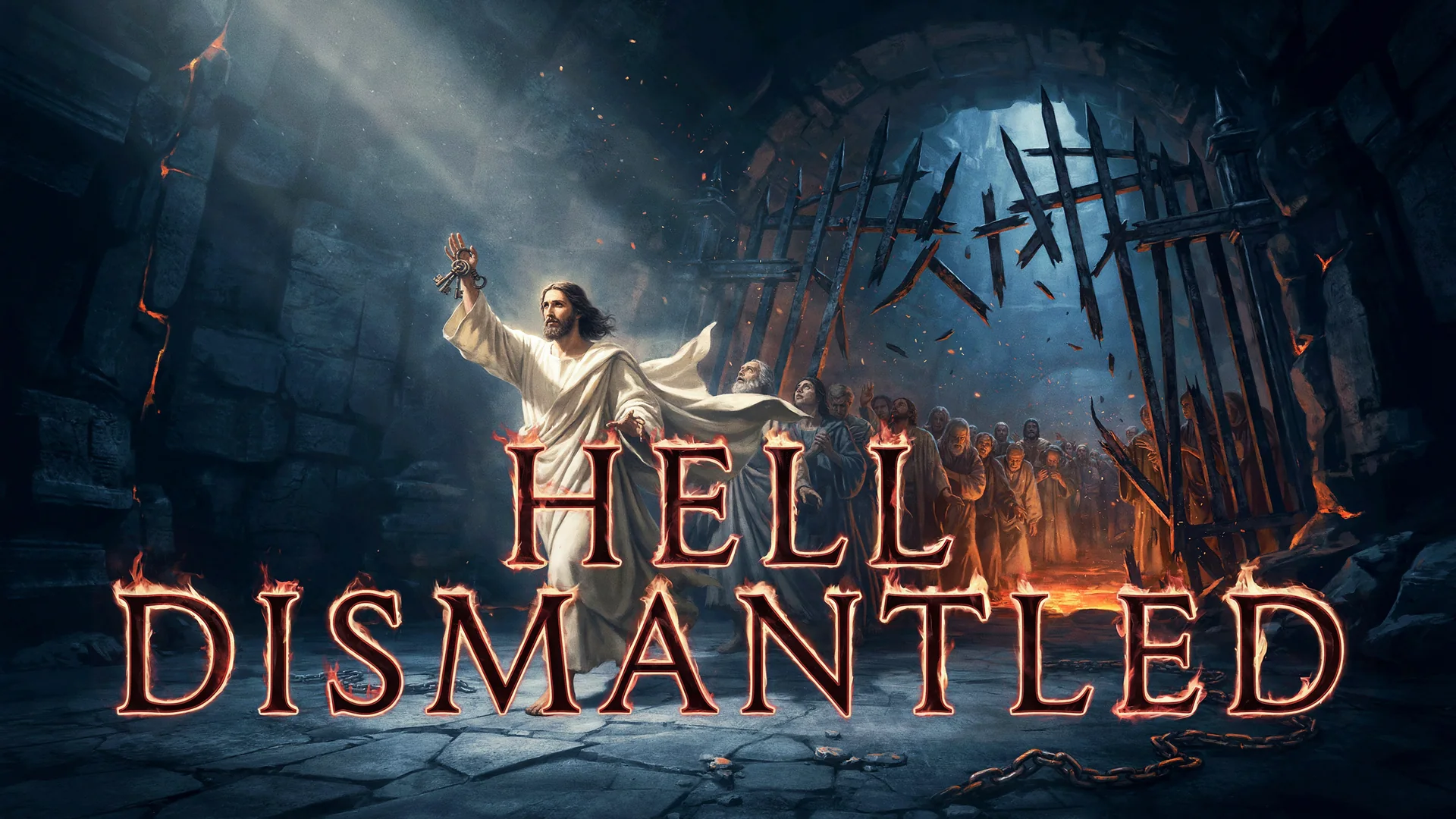
When Jesus died, He descended into that domain. Colossians 2:13-15 says He forgave all trespasses, wiped out the legal certificate of debt, nailed it to the cross, disarmed principalities and powers, and made a public spectacle of them. He went into Hades, preached the Gospel (1 Peter 3:18-20), and led the captives out. Ephesians 4:8-9, quoting Psalm 68:18: “When He ascended on high, He led captivity captive.” He came out victorious, with a procession of freed prisoners behind Him. And He holds the keys.
“I am He who lives, and was dead, and behold, I am alive forevermore. Amen. And I have the keys of Hades and of Death.”
Revelation 1:18
His name is Yeshua. The name literally means “one who saves.” That is not a title. It is a mission description. And now this Savior holds the keys to the very place where the unsaved go. What is the Savior going to do when He has the key to release you? He is going to save. He did not come to destroy men’s lives, but to save them (Luke 9:56). He will not stop saving because you are in Hades. His preaching to the disobedient spirits from Noah’s time (1 Peter 3:19-20) proves it. The dead will hear His voice (John 5:25). Those who hear will live.
And then Philippians 2:10-11: “Every knee should bow, of those in heaven, and of those on earth, and of those under the earth, and every tongue should confess that Jesus Christ is Lord.” Under the earth. That is Hades. Every tongue there will confess. And Romans 10:9 says that if you confess with your mouth the Lord Jesus, you will be saved. Confession is the mechanism of salvation. Every tongue confesses. Every person receives the salvation that confession produces.
No Fire in Hades: The Rich Man, Lazarus, and the Truth
We have examined every Sheol and Hades passage in the Bible: 31 in the Old Testament, 11 in the New Testament. The result is overwhelming: 41 of those 42 passages describe only darkness. Chains of darkness. Outer darkness. Prison. Pit. Not one describes fire as a characteristic of Hades. Not one. Only a single passage references fire in proximity to Sheol (Deuteronomy 32:22), and it describes Yahweh’s fiery anger manifesting as physical curses on the land, not hellfire in the afterlife.
What about Luke 16, the rich man and Lazarus? The rich man is in torment, in flames. Lazarus is in Abraham’s bosom. Most people read this as definitive proof of a fiery afterlife. But this is a parable. And we know that because of how Jesus opens it: “There was a certain rich man.” That is His standard parable formula, identical to Luke 15:11, Luke 16:1, and Luke 19:12. It is addressed to the Pharisees, who loved money (Luke 16:14), in the middle of an entire chapter about the misuse of wealth. And it contradicts every other Hades passage in the Bible, which describe darkness, not fire.
The scholarly record confirms it. George Brown documented in 1878 that this story predates Jesus; it comes from the Babylonian Talmud. Josephus describes an identical Jewish Hades belief. Jesus took a familiar story and used it to rebuke the religious elite who loved money and refused Moses and the prophets. The rich man represents them. The beggar represents those they despised. The moral: if they will not listen to Moses and the prophets, who testified to Jesus, they would not believe even if someone rose from the dead. Which, of course, Someone did. This is masterful teaching. It is not a theology lesson about fire in the afterlife.
All Will Be Saved: Twenty-Nine Scriptures
We have now established: God never burns. The eternity words do not mean eternity. Hell is a mistranslation of four different words. Gehenna is a physical place and a physical curse. Hades has no fire. Jesus holds the keys and preached to the dead. Every tongue confesses. Confession is salvation. Now it is time to look at what the Scripture says positively about the scope of Jesus’ saving work. And it is enormous.
“He Himself is the propitiation for our sins, and not for ours only but also for the whole world.”
1 John 2:2
“God our Savior… desires all men to be saved and to come to the knowledge of the truth. For there is one Mediator between God and men, the Man Christ Jesus, who gave Himself a ransom for all.”
1 Timothy 2:3-6
God’s will is explicit: He desires all men to be saved. Jesus is a ransom for all. 1 John 2:2 says He paid for the whole world. 2 Peter 3:9 says He is not willing that any should perish. John 12:32 says He will draw all peoples to Himself. John 17:2 says the Father gave Him authority over all flesh, and He will give eternal life to as many as were given, and all flesh was given. Luke 3:6: all flesh will see the salvation of God. Romans 11:32: God committed all to disobedience that He might have mercy on all. The scope is universal.
Colossians 1:19-20 says it plainly: it pleased the Father to reconcile all things to Himself, things on earth and things in heaven. Acts 3:21: a restoration of all things. Ephesians 1:10: gathering together in one all things in Christ. Not most things. All things. The Greek word is panta: all, the whole, everything.
And then the Adamology argument from Romans 5:12-19 and 1 Corinthians 15:22. Romans 5 explicitly calls Adam a type of Christ. One man’s one deed negatively affected all of humanity: death, condemnation, the curse. Jesus’ one deed does the opposite (life, justification, restoration), and it does so for all. “As in Adam all die, even so in Christ all shall be made alive” (1 Corinthians 15:22). If Adam’s sin affected 100% of humanity, and Jesus is more powerful than Adam, then Jesus’ righteousness positively affects at least 100% of humanity. The Bible says so. The type demands it. The scope of the second Adam cannot be smaller than the scope of the first.
Father, I receive the truth that You are good, and only good. I receive that Jesus paid for the sins of the whole world. I receive that Your will, that all be saved, will be done. I declare that I am especially saved, because I believe in my heart and confess with my mouth. I walk in every salvation benefit Jesus purchased for me: health, provision, protection, and peace. All of it belongs to me. I lay hold of it now. In Jesus’ name. Amen.
Leviathan Will Be Saved: The Final Revelation
We have come to the final session, and the last revelation is the most stunning of all. If everything we have established is true (if all mankind will ultimately be saved, if God’s scope is truly universal), then what about the worst? What does Scripture say about Leviathan himself?
Job 41 describes Leviathan as the fire-breathing beast: “His sneezings flash forth light… out of his mouth go burning lights, sparks of fire shoot out. Smoke goes out of his nostrils… his breath kindles coals, and a flame goes out of his mouth” (Job 41:18-21). Dragon qualities. Fire from the mouth. Smoke. Coals. The king over all the children of pride.
Now read Psalm 18:6-15, which describes Yahweh in the Old Testament: “Smoke went up from His nostrils, and devouring fire from His mouth; coals were kindled by it… He made darkness His secret place… coals of fire… lightnings in abundance.” Every single attribute of Leviathan in Job 41 is present in Psalm 18’s description of Yahweh. Fire from mouth. Smoke from nostrils. Coals kindled. Lightnings. Darkness as a dwelling. They are describing the same entity. Much of what the Old Testament attributes to the name Yahweh (fire, destruction, darkness, wrath) is actually the fire-from-heaven beast. This is why we must rightly divide. And Revelation 12:9 confirms who the great dragon is: “that serpent of old, called the Devil and Satan, who deceives the whole world.”
“In that day the LORD with His severe sword… will punish Leviathan the fleeing serpent… Or let him take hold of My strength, that he may make peace with Me; and he shall make peace with Me.”
Isaiah 27:1, 5
Right there, God says it: Leviathan can take hold of My strength. He can make peace with Me. And this is not a maybe or a possibility: he shall make peace with Me. It is a declared outcome. The fire-breathing beast will repent. The dragon will be restored. The deceiver of the whole world will make peace with God.
Now consider the logic. If the worst of the worst (the beast himself, the entity who led all humanity astray, whose deception is the very source of all sin in the world) will be saved, then how much more will every human being he deceived be saved? If Adam following the devil could ruin things for all mankind, then the devil himself repenting and turning to God can only further secure the restoration of all things. This is God’s plan. This is His scope. This is the full magnitude of what Jesus purchased on the cross.
The Life Cycle: Where Does “Hell” Actually Fit?
Sinner hears the Gospel → Repents and is born again → Receives especially salvation now: health, protection, provision, peace, wisdom, victory → Dies in strength at a ripe age → Sleeps until judgment → Paradise. The full-benefit path. This is what we want. This is what Jesus purchased.
Sinner refuses the Gospel → Under curse of the law: sickness, enemies, calamity, destruction → For those under the law in Jesus’ generation: physical curse including Gehenna (the AD 70 siege of Jerusalem: madness, famine, slaughter, bodies cast into the Valley of Hinnom) → Death → Spirit descends to Sheol/Hades (darkness and anguish, not fire) → Maximum 3 days → Hears the Gospel preached by Jesus → Every knee bows, every tongue confesses → Confession = salvation → Purifying fire cleanses sin → Paradise.
The Valley of Hinnom on the southwest side of Jerusalem. Physical place. Physical curse. Worms eating physical corpses. Fires burning physical waste. This is what Jesus warned His contemporaries about in Matthew and Luke: the coming curse under the law. Fulfilled in AD 70: Rome destroyed Jerusalem, 1.1 million died, bodies were thrown over the walls into the valley. Gehenna is a this-life curse that precedes death. It is not the spiritual afterlife. It is not Hades. They are two different things.
All things reconciled (Colossians 1:20). All things restored (Acts 3:21). All gathered in Christ (Ephesians 1:10). Every knee bows, every tongue confesses (Philippians 2:10-11). Even Leviathan the beast shall make peace with God (Isaiah 27:5). The will of God, that all be saved (1 Timothy 2:4), is accomplished.
The Eleven Major Revelations
After nine sessions and hundreds of scriptures, here is what the Bible actually says. Not what tradition told us, but what the original languages, historical context, and honest exegesis reveal:
God declared burning people alive an evil abomination 15–20 times in the Old Testament. He never changes and is not a hypocrite. He will never burn anyone alive: not now, not for eternity.
Olam, aion, aionios do not mean “eternity” by default. They mean an unspecified age of time. Context determines the length. Hundreds of Scripture examples prove the mistranslation.
“Hell” is a fabricated word merging four different concepts: Sheol and Hades (spiritual realm of the dead), Tartarus (sub-chamber for fallen angels), and Gehenna (physical valley outside Jerusalem). They are not the same thing.
Gehenna is on the map, southwest of Jerusalem. Every worm-and-fire passage traces to Isaiah 66:24 and the physical AD 70 curse. Zero connection to spiritual afterlife.
The maximum time in Hades is three days, proven by Jesus’ payment for all humanity, Jonah’s three days in the fish, and Egypt’s three days of darkness. Three witnesses. Established.
God’s fire purifies, it does not torture. Isaiah with the live coal. Malachi’s refiner’s fire. 1 Corinthians 3: a man can pass through fire and still be saved. God destroys sin, not people.
Jesus preached to the dead in Hades (1 Peter 3:19-20; John 5:25). He led captives out (Ephesians 4:8). The Savior with the keys will save. That is what Saviors do.
“Fear him who kills and casts into Gehenna” is Satan (Hebrews 2:14), not the Father. The Father loves sparrows. He is harmless (Hebrews 7:26). Do not fear Him; fear the curse. Believe the Redeemer.
Adamology (Romans 5:12-19): Adam broke things for all humanity. Jesus fixes things for all humanity. If 100% were condemned in Adam, 100% are restored in Christ. The type demands it.
29 scriptures say all will be saved, reconciled, restored, gathered, and drawn to Christ. God desires all to be saved (1 Tim 2:4). He is not willing that any perish (2 Pet 3:9). His will shall be done.
Even Leviathan the fire-breathing beast will repent and make peace with God (Isaiah 27:5). If the worst is saved, how much more all humanity he deceived? God’s plan is exponentially greater than the church has ever taught.
A God Worth Loving
Here is what we have proved from Scripture alone. God declared burning alive an evil abomination. His fire purifies; it does not torture. The eternity words in our Bibles are not eternity words; they are age words, and every age has a beginning and an end. “Hell” is four different words describing four different things, and the only one with fire is Gehenna, which is a physical valley in Jerusalem associated with the AD 70 curse. Hades is darkness, not fire. Jesus holds the keys. Every tongue confesses. Confession is salvation. The Savior with the keys will save. Even the beast himself will repent. And Scripture, in passage after passage, declares that God’s good will, the salvation of all, will ultimately be accomplished.
This does not mean it does not matter how we live. It matters more than ever. The believer is especially saved. We have salvation benefits in this present life: health, protection, provision, peace, wisdom, and victory. We do not want to waste this life or take a shortcut through Hades. We want every bit of what Jesus purchased.
But the God who emerges from this study, the true God revealed perfectly in the face of Jesus Christ, is not the tyrant who tortures forever. He is the Father who wept over Jerusalem. He is the one who sent His Son not to condemn the world but to save it (John 3:17). He is the Savior who descended into the darkest place and came out with prisoners behind Him. He is the vine dresser who prunes for fruitfulness, not the judge who burns for punishment. He is the Father who desires all to be saved and will not stop working until that desire is fulfilled. He is light, and in Him is no darkness at all. Amen.
Father, I receive who You truly are. You are good, and You are only good. You never change. You are not a torturer. You are a Savior. You are the answer to every curse, every sickness, every death, every darkness. Jesus is Your express image, and He is all that You are: healing, restoring, raising, saving. I declare that I am especially saved. I believe in my heart and confess with my mouth that Jesus is Lord. Every salvation benefit belongs to me now: health, provision, protection, and peace. And I declare that Your will (that all be saved, all be reconciled, all be restored) shall be done. In Jesus’ name. Amen.